When your chest is tight and your thoughts are sprinting, breathing is one of the few things you can change on the spot. You don't need an app, a mat or a quiet room. Just a few slow breaths, counted out on purpose. Two methods dominate the conversation: box breathing and 4-7-8.
Both are simple, free and take about a minute to learn. They look similar on paper, but they feel different in practice, and each suits a different moment of your day.
In this guide you'll learn how each technique works, what the science does and doesn't tell us, which one to reach for and when, and how to build a gentle five-minute habit across one week. There's also a comparison table, common mistakes and a few safety notes.
What Is Box Breathing?
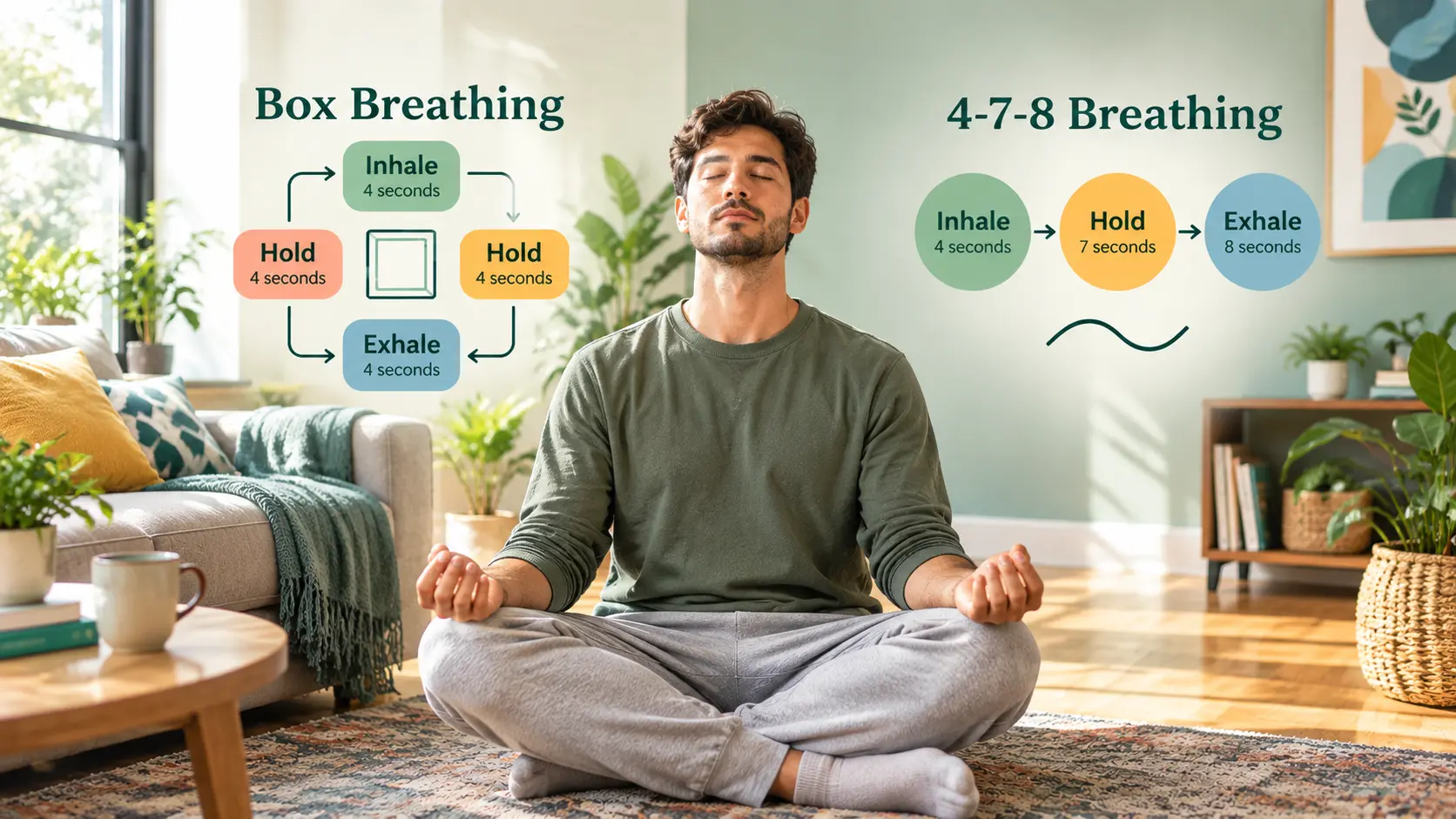
Box breathing is a slow, even pattern where every part of the breath lasts the same number of seconds. You breathe in, hold, breathe out and hold again, each for a count of four. Picture tracing the four sides of a square: that's where the name comes from.
It is often linked with high-pressure jobs, where people learn to steady themselves before a demanding moment. The appeal is obvious: it is easy to remember, gives your mind a simple task, and can be done almost anywhere without anyone noticing.
How to Do Box Breathing, Step by Step
1. Sit upright but comfortably, with your feet on the floor and your shoulders loose.
2. Breathe out gently to empty your lungs.
3. Breathe in slowly through your nose for a count of 4.
4. Hold your breath for a count of 4.
5. Breathe out slowly through your nose or softly through your mouth for a count of 4.
6. Hold, with your lungs empty, for a count of 4.
7. Repeat for 4 to 8 rounds, then let your breathing return to normal.
If holding feels uncomfortable, shorten the count. Plenty of people start with 3-3-3-3 and that works perfectly well.
What Is 4-7-8 Breathing?
The 4-7-8 method is a different shape entirely. The out-breath is much longer than the in-breath, and the hold sits in the middle. It was popularised by Dr Andrew Weil, the American integrative medicine doctor, who has described it as based on a yogic breathing practice known as pranayama.
Because the exhale is the longest part, many people find it more soothing, though counting to eight takes some getting used to.
How to Do 4-7-8 Breathing, Step by Step
1. Sit comfortably, or lie down if you are in bed. Rest the tip of your tongue lightly behind your upper front teeth.
2. Breathe out fully through your mouth, making a soft whoosh sound.
3. Close your mouth and breathe in quietly through your nose for a count of 4.
4. Hold your breath for a count of 7.
5. Breathe out slowly through your mouth for a count of 8.
6. That is one round. Repeat for up to 4 rounds to begin with.
The numbers describe a ratio more than a rule. If 4-7-8 feels like too much, try a simple 2-4-6 (in for two, hold for four, out for six) and count at a pace that suits your lungs.
How Slow Breathing Affects Your Body
Here's the short version of what is going on. Your autonomic nervous system, the part that runs things you don't think about, has two broad modes. One prepares you for action. The other helps you rest and settle. Your breathing sits in an unusual spot: it runs automatically, yet you can take control of it whenever you like.
When you slow your breathing and make the out-breath a little longer, heart rate tends to dip slightly as you exhale, and many people feel their body begin to calm. Researchers often describe this as a shift towards the rest side of the nervous system.
Now for the honest part. Studies of slow, controlled breathing have found promising effects on stress, mood and measures such as heart rate variability. But many of those studies are small, they use different methods, and it is hard to separate the effect of the breathing from the effect of simply sitting quietly for a few minutes. There is far less research on box breathing and 4-7-8 specifically than there is on slow breathing in general, and I'm not aware of solid head-to-head trials proving that one is better than the other.
So treat both as tools, not treatments. They may help you feel steadier in the moment. They are not a cure for anxiety, insomnia or any medical condition.
Box Breathing vs 4-7-8: Which Should You Use?
The simplest way to choose is to ask what you need right now: to feel focused and level, or to slow right down.
Box Breathing for Stress and Focus
Because the in-breath and out-breath are equal, box breathing tends to feel steady rather than sedating. That makes it a good fit for moments when you need to stay alert and composed:
- Five minutes before a meeting or presentation
- While waiting for difficult news or a tough conversation
- When you notice your shoulders creeping up towards your ears
If stress has been building for weeks rather than minutes, a breathing exercise is a helpful small step but not the whole answer. Our guide to recovering from burnout looks at the bigger picture of rest, boundaries and support.
4-7-8 for Winding Down
The long exhale and slower rhythm make 4-7-8 a popular choice in the evening. Try it once you are already in bed, or on the sofa as part of your wind-down. Many people also use it when thoughts are looping. If that sounds familiar, pairing it with the ideas in our piece on how to stop overthinking gives your mind something to do and a few ways to let go.
One caution: no breathing technique will promise you sleep. Think of it as one part of a calm evening, not a switch. Your habits around bedtime matter just as much, and our guide to fixing your sleep schedule covers the routine side in more detail.
Box Breathing vs 4-7-8 at a Glance
Box breathing | 4-7-8 breathing | |
Pattern | In 4, hold 4, out 4, hold 4 | In 4, hold 7, out 8 |
Out-breath | Same as in-breath | Twice as long as in-breath |
Feels like | Steady and focused | Slow and settling |
Best for | Daytime stress, before meetings | Evening wind-down |
Gentler version | 3-3-3-3 | 2-4-6 |
Neither is "better" in every situation. Plenty of people use box breathing by day and 4-7-8 at night.
Beginner Tips for Getting Started
A few small choices make the first week far more comfortable.
- Start with shorter counts. Try 3-3-3-3 for box breathing or 2-4-6 for a calming ratio. You can lengthen the counts later, or never.
- Sit comfortably. A chair with your back supported is ideal. You can also lie down for evening practice.
- Breathe through your nose where you can. It tends to slow the breath naturally.
- Do not force it. If you feel lightheaded, dizzy or panicky, stop and breathe normally. Breathing should feel like a release, not a test.
Common Mistakes to Avoid
- Counting too long, too soon. Long holds can leave you gasping. Shorter counts done calmly beat longer counts done tensely.
- Breathing too deeply. Taking huge breaths can make you lightheaded. Think slow and soft rather than big.
- Gripping the breath. If your jaw, shoulders or stomach tighten during the holds, shorten them or skip them for now.
- Only trying it in a crisis. Practise when you're already fairly calm, so the pattern feels familiar when you need it.
A 5-Minute Practice Plan for One Week
Five minutes a day is plenty. If you can't manage five, do two. Consistency matters more than length.
Day | Practice | Time |
Monday | Box breathing 3-3-3-3, seated | 5 minutes |
Tuesday | Box breathing 3-3-3-3, then try 4-4-4-4 if it feels easy | 5 minutes |
Wednesday | Gentle 2-4-6 breathing, seated | 5 minutes |
Thursday | Box breathing 4-4-4-4 before a task or meeting | 5 minutes |
Friday | 4-7-8 for 3 or 4 rounds in the evening, seated | 5 minutes |
Saturday | Slow breathing paired with an easy walk | 5 minutes |
Sunday | Your choice: whichever felt best this week | 5 minutes |
On Saturday, try matching your breath to your steps, for example in for three steps and out for four. If you enjoy combining breath and movement, our walking and yoga routine shows one easy way to do it.
At the end of the week, jot down when you felt calmest. That tells you what suits you.
Who Should Be Careful?
Slow breathing is gentle for most people, but breath holds and unusual patterns aren't right for everyone. Talk to a doctor or other healthcare professional before you start if any of these apply:
- Asthma or COPD. Holding your breath or breathing against resistance may not feel comfortable. Ask your doctor what is suitable, and skip the holds in the meantime.
- Pregnancy. Many pregnant people find gentle breathing helpful, but it is sensible to check with your midwife or doctor before doing long breath holds.
- Anxiety or panic that gets worse with breath-holding. For some people, focusing on the breath or holding it increases the feeling of panic. Try breathing without holds, or choose a different calming method, such as a slow walk.
- Heart conditions or fainting. Check with your doctor first.
Whatever your health, stop if you feel dizzy, short of breath or unwell. And if you are struggling with persistent anxiety, poor sleep or low mood, please speak to a professional rather than relying on breathing exercises alone.
Frequently Asked Questions
Which is better, box breathing or 4-7-8?
Neither is better overall. Box breathing suits daytime moments when you want to feel steady and focused. 4-7-8 is popular for slowing down in the evening. Try both for a week and see which fits you.
How long does box breathing take to work?
Some people notice a difference within a couple of minutes, while others need a few days of practice before it feels natural. Results vary, and it isn't a quick fix for everything.
Can I do 4-7-8 breathing every day?
Most healthy adults can practise it daily, starting with about four rounds. Keep it gentle and stop if you feel dizzy. If you have a health condition, ask your doctor first.
Will box breathing help me sleep?
It might help you feel more relaxed before bed, which can make sleep feel easier. But it won't guarantee sleep, and if you have ongoing sleep problems, a healthcare professional can help.
Is box breathing safe for anxiety?
Many people with everyday stress find it calming. If breath-holding makes you feel more anxious, drop the holds and just breathe out slowly. Persistent anxiety deserves proper support from a doctor or therapist.
The Bottom Line
Box breathing and 4-7-8 are two small, free ways to give your body a moment to settle. Box breathing is a steady companion for busy days. 4-7-8, with its long out-breath, is a gentle option for slowing down in the evening. The research on slow breathing is encouraging but still limited, so approach both with curiosity rather than big expectations.
Start gently, keep the counts short, and stop if anything feels off. Five calm minutes a day, repeated for a week, is a good place to begin.
This article is for general information only and is not medical advice. If you have a medical condition, are pregnant, or have concerns about your breathing, anxiety or sleep, please speak to a doctor or qualified health professional.