Some days a full yoga class feels like too much. You'd have to find a mat, a quiet room and the energy to commit to an hour. Other days a brisk walk feels too plain, and your mind wanders off to your to-do list after the first five minutes.
Walking yoga sits neatly between the two. You get outside, keep moving at an easy pace, and add a handful of gentle stretches and breathing moments along the way. No mat, no studio, no special clothes. Just you, your trainers and a bit of open space.
This guide explains what walking yoga is, why it has become so popular this year, what it can do for you, and gives you a simple 20-minute routine to try today.
What Is Walking Yoga?
Walking yoga is exactly what it sounds like: a mix of mindful walking and simple yoga-style movement. Instead of stepping onto a mat, you walk slowly and deliberately, pausing every so often to stretch, open your chest, balance on one leg or take a few deep breaths.
There's no official rulebook. Different teachers do it differently. Some focus on slow, mindful steps with coordinated breathing. Others add poses such as a standing forward fold, a side stretch or a tree pose at set points along the route. The version in this guide is beginner friendly and uses only movements most people can do in everyday clothes.
The core ideas stay the same:
Slow, relaxed pace. This isn't a power walk. Think of it as a calm stroll with your full attention.
Breathing with your steps. You match your breath to your pace, which helps the body settle.
Gentle stretching. Short, easy poses release tension from the places that walking alone leaves tight.
Awareness of your body. You notice how your feet land, how your shoulders sit and where you're holding stress.
Why Is Walking Yoga Trending?
Search interest in walking yoga jumped by about 2,414% in a year, according to PureGym's annual fitness report, which compared Google searches from July to September 2024 with the same months in 2025. It ranked as one of the fastest-growing fitness trends, behind only Japanese walking.
There are a few clear reasons why:
1. People want gentler exercise. After years of intense workouts and fitness challenges, many people are looking for movement that feels kind to their body instead of punishing.
2. It fits busy lives. You can do it on a lunch break, after dinner or on a weekend morning, without booking a class.
3. It's good for stress. Slow walking, deep breathing and time outdoors all help the mind settle, and many of us are carrying more stress than ever, which can build into burnout.
4. It costs nothing. No membership, no equipment and no experience needed.
5. It's easy to share. Short clips of simple routines spread quickly on social media, which brought the idea to millions of new people.
The wider picture matches this too. The American College of Sports Medicine's 2026 trends survey ranked exercise for mental health up to number six, and balance, flow and core strength formats like yoga and Pilates in the top five. People are clearly looking for movement that supports how they feel, not only how they look.
The Benefits of Walking Yoga
Walking yoga hasn't been studied as a single method in large trials, so it's worth being honest about what we know. But the two things it combines, walking and yoga-style stretching, each have solid evidence behind them. Here's what you can reasonably expect.
It can ease stress and lift your mood. Walking outdoors and slow, deep breathing are both linked with lower stress and better mood. Combining them gives you a double dose of calm.
It keeps your joints moving. Gentle stretches through your hips, spine and shoulders help counter the stiffness that comes from sitting at a desk all day.
It improves balance. Standing on one leg during a walk challenges the small stabilising muscles in your feet, ankles and hips. Good balance matters more as we get older, because it helps prevent falls.
It improves posture. Many of the moves open the chest and lengthen the spine, which gives your upper body a break from slouching over a screen.
It's easy on your body. There's no jumping, twisting under load or heavy lifting, so it suits people who find high-impact exercise uncomfortable.
It builds a habit that sticks. Because the routine feels easy and pleasant, you're more likely to do it again tomorrow. And for most of us, consistency matters more than intensity.
What You Need Before You Start
Very little:
Comfortable shoes with some grip, like trainers or flat walking shoes.
Loose, stretchy clothes that let you bend and reach.
A safe, fairly flat route such as a park path, a quiet street or a garden. Around 100 to 200 metres of straight path is plenty, because you can walk it back and forth.
A water bottle if it's warm.
Optional: your phone on silent, or a timer, so you can follow the minutes without checking.
Try to avoid wet grass, icy ground and uneven stones for the standing balance moves. Safety comes first.
A 20-Minute Walking Yoga Routine for Beginners
The routine has five parts: arrive, walk and breathe, stretch, balance, and slow down. Go at a pace that feels comfortable, and skip or soften anything that doesn't feel right for your body.
Part 1: Arrive (2 minutes)
Stand still at the start of your path. Let your arms hang by your sides and your feet sit hip-width apart. Close your eyes if you feel safe doing so, or soften your gaze. Take three slow breaths in through your nose and out through your mouth. Notice how your feet feel against the ground.
This tiny pause matters. It tells your body that you're about to do something different from rushing to the shops.
Part 2: Mindful Walk and Breathing (5 minutes)
Begin walking at a slower pace than usual, about half your normal speed. Let your arms swing gently. Now bring your attention to three things:
1. Your feet. Feel your heel land, then the ball of your foot, then your toes pushing off.
2. Your breath. Breathe in for three steps and out for three steps. If that feels too long, try two steps in and two steps out. Don't force it.
3. Your shoulders. Every few steps, drop them away from your ears and unclench your jaw.
If your mind wanders, which it will, simply bring it back to your feet. That's the whole practice.
Part 3: Gentle Stretches on the Move (6 minutes)
Here you stop every 20 to 30 steps to do one of the following. Hold each stretch for three slow breaths, then carry on walking.
Reach and lengthen. Stand tall, breathe in and raise both arms overhead, palms facing each other. Breathe out and lower them. This opens the chest and wakes up your spine.
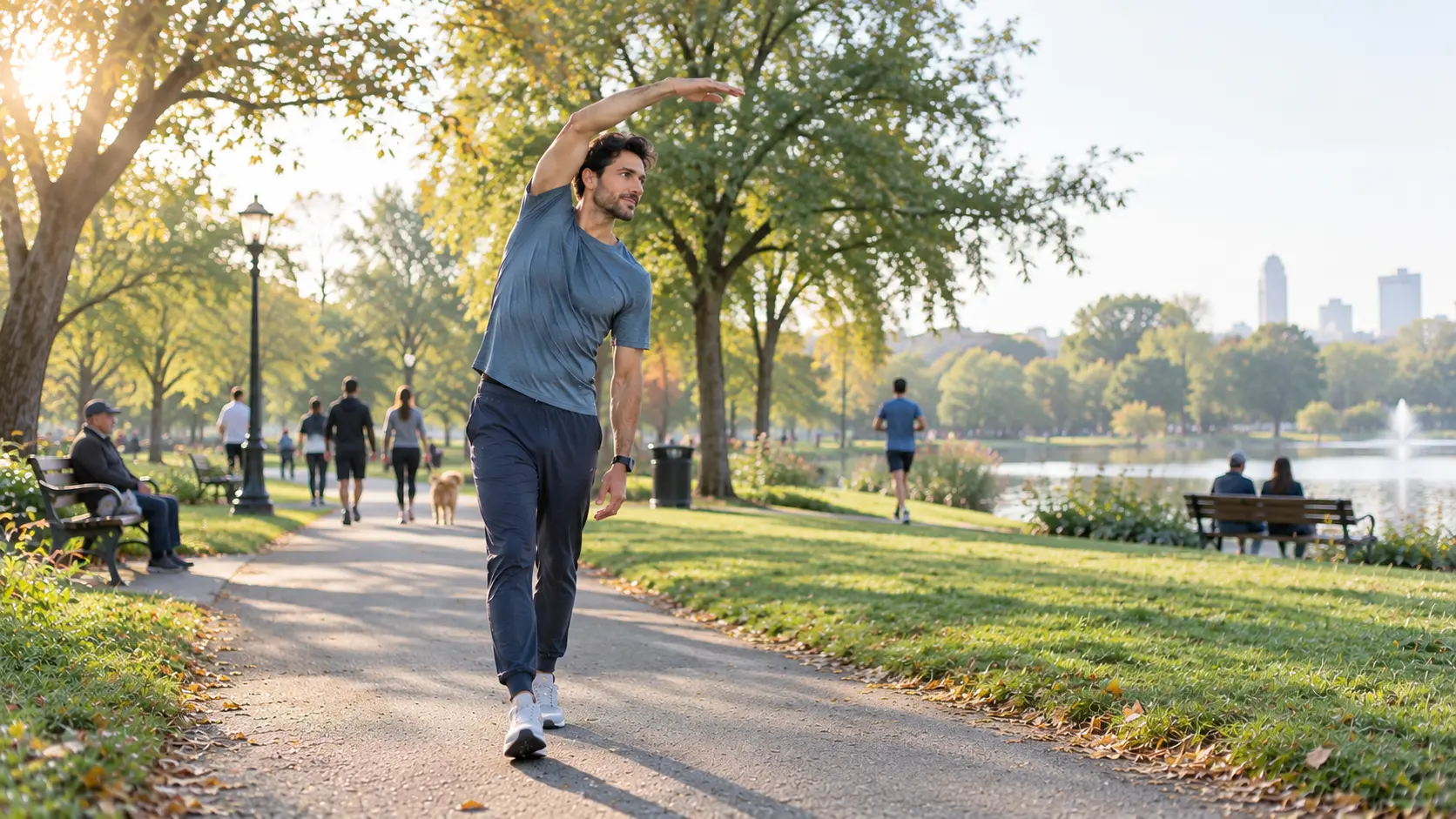
Standing side bend. With your arms overhead and your hands clasped or holding opposite wrists, lean gently to one side. Pause, return to centre and lean to the other side. Keep your hips facing forward.
Chest opener. Clasp your hands behind your back, straighten your arms and lift your chest. If your hands won't clasp, hold a towel or scarf between them. Perfect for anyone who spends hours at a desk.
Standing forward fold. Hinge at the hips with your knees soft and let your head and arms hang heavy. Don't worry about touching the floor. Roll up slowly, one bone at a time, to avoid feeling dizzy.
Gentle twist. Stand tall, place your right hand on your left hip and your left hand on your lower back, and turn your upper body slowly to the left. Hold for three breaths, then switch sides.
Calf and ankle stretch. Take a long step forward and keep your back heel on the floor. Lean into the front knee until you feel a stretch along the back leg. Switch sides.
Part 4: Balance Moments (4 minutes)
Balance work is where walking yoga gets a little more interesting. Do these near something you could reach for, such as a tree, a fence or a bench.
Slow-motion steps. Walk in very slow motion, taking about five seconds per step. Pause on each leg for a moment before you lift the other foot. This quickly shows you how steady you really are.
Tree pose. Stand on one leg and rest the sole of your other foot against your calf or ankle, never the side of the knee. Bring your hands to your chest. Hold for five breaths, then switch.
Heel-to-toe walk. Walk along an imaginary line, placing the heel of one foot directly in front of the toes of the other. Keep your eyes forward. Do 10 steps, turn and come back.
If any of these feel wobbly, that's useful information, not a failure. Keep a hand on your support, and the steadiness will come with practice.
Part 5: Slow Down and Finish (3 minutes)
Walk at your slowest pace for a minute, letting your breathing return to normal. Then stop, stand tall, place one hand on your chest and one on your belly, and take five deep breaths. Finish with a quiet thank you to your body for moving.
That's it. Twenty minutes, no mat and no equipment.
The Routine at a Glance
Part | Time | What you do |
Arrive | 2 min | Stand still, three slow breaths |
Mindful walk | 5 min | Slow pace, breathe in for 3 steps and out for 3 |
Gentle stretches | 6 min | Stop every 20 to 30 steps for a short stretch |
Balance moments | 4 min | Slow-motion steps, tree pose, heel-to-toe walk |
Slow down | 3 min | Slowest walk, hands on chest and belly, five deep breaths |
Tips and Common Mistakes
Don't rush. If you're finishing the routine in ten minutes, slow down.
Don't hold your breath during stretches.
Never push into pain. A gentle pull is fine. Sharp pain means stop.
Start with once or twice a week, then build up to most days.
Frequently Asked Questions
Is walking yoga good for beginners?
Yes. It needs no flexibility or experience, and you control the pace.
Does it count as exercise?
It's a light activity, so it's best seen as a gentle complement to brisker walks and strength training, not a replacement. Check with your doctor first if you have balance problems or a health condition.
How often should I do it?
Two or three times a week is a good start. Once the routine feels easy, you can do it daily, or add a few of the stretches to your normal walks.
Can I do it indoors?
Yes. Walk back and forth across a room or hallway and do the same stretches and balance moves. Outdoors is nicer for your mood, but the benefits come from the movement and the breathing.
Who should be careful?
People with dizziness, balance problems, recent surgery or joint pain should speak to a doctor first and keep a hand on a support during the balance moves. If you feel faint or unwell at any point, stop and sit down.
The Bottom Line
Walking yoga turns an ordinary walk into a small reset for body and mind. Try the 20-minute routine this week, or make it part of a weekly reset day. Keep it easy, and notice how you feel afterwards. One calm walk is a good habit to start.
This article is for general information and is not medical advice. If you have a health condition or injury, speak to your doctor before starting a new exercise programme.