If you've ever walked into a gym, looked at the racks of weights, and walked straight back out, you're not alone. Strength training can feel like something meant for other people. People with matching gym outfits and protein shakes, who seem to know exactly what they're doing.
Here's the good news. You don't need a gym, expensive equipment, or an hour a day for strength training at home. You need a bit of floor space, about 30 minutes, and a plan you can stick to.
This guide gives you that plan. Six basic moves, three days a week, and a clear way to make progress over the next six weeks. No jargon, no punishing workouts, just a steady start.
Why Strength Training Is Worth Your Time
Most of us think of exercise as cardio: walking, running, cycling. Those are great for your heart. But building muscle does things cardio alone can't.
It keeps you strong for everyday life. Carrying shopping bags, lifting a child, climbing stairs, getting up off the floor. These are all strength tasks. The stronger you are, the easier daily life feels.
It protects your body as you age. Adults slowly lose muscle from their thirties onwards if they don't use it. Regular strength work slows that loss and also helps keep bones strong.
It supports a healthy weight. Muscle uses more energy than fat, even at rest. Strength training alone won't melt fat, but it helps you hold on to muscle when you're trying to lose weight, so the weight you lose is more likely to be fat.
It's good for your mind. Many people find that finishing a set they couldn't do a month ago gives a real boost of confidence. Research also links regular muscle-strengthening exercise with better mood and lower anxiety.
The World Health Organization recommends that adults do muscle-strengthening activities on at least two days a week. The plan below gives you three, which leaves room to miss one and still stay on track.
How Strength Training Actually Works
Your muscles get stronger when you ask them to do a little more than they're used to, then give them time to recover. That's it. Trainers call this "progressive overload", but you can think of it as "a little harder, a little at a time."
The workout itself creates tiny stresses in the muscle. The rest days afterwards are when your body repairs and rebuilds that muscle a bit stronger. This is why rest days matter just as much as workout days, and why the plan has a day off between each session. Sleep matters too, because that is when most recovery happens, so a steady sleep schedule helps.
Two more terms you'll see below:
- Reps (repetitions): how many times you do a move in a row. Ten squats = 10 reps.
- Sets: a group of reps. "3 sets of 10" means 10 squats, rest, 10 more, rest, 10 more.
What You Need to Get Started
Very little. Here's the basic kit:
- A clear space about the size of a yoga mat, with room to stretch your arms.
- A mat or carpet to make floor moves comfortable.
- A sturdy chair or step for some of the easier versions.
- Optional: a pair of light dumbbells, or two full water bottles, for later weeks.
- Comfortable clothes and trainers (or bare feet on a non-slip mat).
That's all. You can add a resistance band or heavier weights later, once the basics feel easy.
The 6 Beginner Moves
These six moves cover your whole body: legs, hips, chest, back, shoulders and core. Learn the form first. Speed and weight can come later.
1. Squat (legs and glutes)
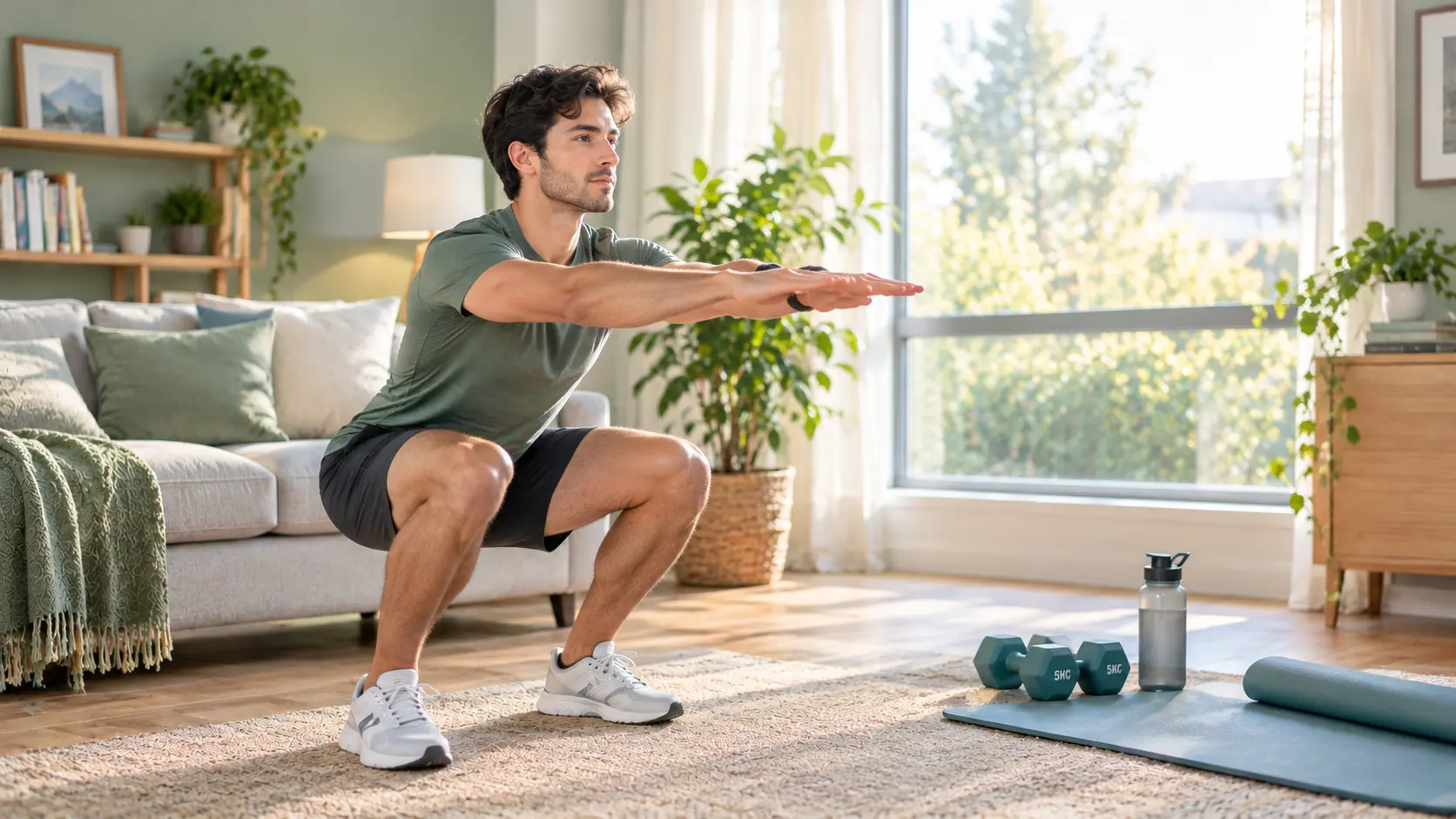
Stand with your feet a little wider than your hips, toes pointing slightly out. Push your hips back as if you're about to sit in a chair, and bend your knees. Go down as far as feels comfortable, keeping your chest up and your heels on the floor. Push through your whole foot to stand back up.
Easier: squat down to a chair, touch it lightly, and stand back up.
Harder: hold a dumbbell or water bottle at your chest.
2. Push-Up (chest, shoulders and arms)
Place your hands on the floor slightly wider than your shoulders. Keep your body in a straight line from head to heels, then lower your chest towards the floor and push back up.
Easier: do push-ups with your hands on a wall or kitchen counter. The higher your hands, the easier it is. Knee push-ups on the floor are the next step.
Harder: slow the lowering part down to three seconds.
3. Glute Bridge (hips, glutes and lower back)
Lie on your back with your knees bent and feet flat on the floor, hip-width apart. Squeeze your glutes and lift your hips until your body forms a straight line from shoulders to knees. Hold for a second at the top, then lower slowly.
Easier: make the movement smaller.
Harder: do it with one leg straight out in front of you.
4. Bent-Over Row (upper back and arms)
Hold a dumbbell or water bottle in each hand. Bend your knees slightly and hinge forward at the hips until your upper body is at about a 45-degree angle, back flat. Pull the weights up towards your lower ribs, squeezing your shoulder blades together, then lower them slowly.
Easier: use lighter weights or rest one hand on a chair and row with one arm at a time.
Harder: use heavier weights or pause for two seconds at the top.
5. Reverse Lunge (legs, balance)
Stand tall. Step one foot back and lower your back knee towards the floor until both knees are bent at roughly 90 degrees. Push through your front heel to return to standing. Switch legs.
Easier: hold the back of a chair for balance and take a shorter step.
Harder: hold a dumbbell in each hand.
6. Forearm Plank (core)
Rest on your forearms with your elbows under your shoulders. Step your feet back so your body forms a straight line. Tighten your stomach as if someone were about to poke it, and breathe normally. Don't let your hips sag or rise up.
Easier: plank with your knees on the floor.
Harder: add 10 seconds each week.
Your 3-Day Weekly Plan
Do the full workout three times a week with a rest day in between, for example Monday, Wednesday and Friday. Each session takes 25 to 30 minutes.
Warm-up (5 minutes): march on the spot, roll your shoulders, swing your arms, and do 10 slow bodyweight squats.
Move | Sets | Reps or time | Rest between sets |
Squat | 2 | 10 | 60 seconds |
Push-up (wall or knee) | 2 | 8 | 60 seconds |
Glute bridge | 2 | 12 | 45 seconds |
Bent-over row | 2 | 10 | 60 seconds |
Reverse lunge | 2 | 8 each leg | 60 seconds |
Forearm plank | 2 | 20 seconds | 45 seconds |
Cool-down (5 minutes): gentle stretches for your thighs, hips, chest and shoulders. Hold each one for about 20 to 30 seconds and breathe slowly.
On your rest days, try to stay active in a light way. A walk, some gentle stretching, walking yoga or a bit of gardening all count.
How to Progress Over 6 Weeks
The plan only works if it slowly gets harder. Here's a simple way to build up without overdoing it:
Weeks | What changes |
1 to 2 | Learn the moves. 2 sets of each. Focus on form, not speed. |
3 to 4 | Move to 3 sets of each. Add 2 reps per set if it feels easy. |
5 to 6 | Try the "harder" version of two or three moves, or add light weights. |
A good rule: if you can finish every set with two or three reps "left in the tank", it's time to make it a little harder. If your form breaks down before the last rep, stay where you are for another week.
Write your sets and reps down in a notebook or on your phone. Seeing your numbers go up week by week is one of the best ways to stay motivated.
Common Beginner Mistakes
Rushing the reps. Fast, bouncy reps use momentum instead of muscle. Take about two seconds to lower and one second to lift.
Holding your breath. Breathe out as you push or lift, and breathe in as you lower.
Skipping the warm-up. Five minutes of easy movement gets your joints ready and lowers your risk of strains.
Doing too much in week one. Feeling a bit sore a day or two later is normal. Being too sore to walk down the stairs means you did too much. Start smaller than you think you need to.
Giving up after a missed session. Life happens. If you miss a day, just do the next workout. One missed session won't undo your progress, but quitting will. A weekly reset day is a good moment to put your three workout slots in your diary.
Will I Get "Bulky"?
This is one of the most common worries, especially among women, and the short answer is no. Building large, bulky muscles takes years of heavy, focused training and a very specific diet. A few sessions a week at home will make you stronger, firmer and more toned, not bulky.
What to Eat to Support Your Workouts
You don't need a special diet to start. But your muscles need protein to recover, so try to include a source of protein at each meal: eggs, yoghurt, lentils, beans, chicken, fish, tofu or paneer all work well.
Drink water before and after your workout, and don't train on a completely empty stomach if it makes you feel dizzy. A banana or a small yoghurt about an hour before is plenty. If you have a sweet tooth, high-protein desserts are an easy way to top up your protein.
Frequently Asked Questions
How long until I see results?
Most beginners feel stronger within two to three weeks, because your brain gets better at using the muscle you already have. Visible changes in muscle tone usually take six to eight weeks of regular training.
Can I do this workout every day?
It's better not to. Your muscles need about 48 hours to recover after a full-body strength session. Three days a week, with rest days in between, gives you the best balance of effort and recovery.
Do I need weights?
Not at the start. Your body weight is enough for the first few weeks. When the moves get easy, add light dumbbells, water bottles, or a backpack with books in it.
I'm over 50. Is this plan safe for me?
For most healthy adults, yes, and strength training becomes even more valuable with age. Start with the easier versions, use a chair for support, and check with your doctor first if you have heart problems, joint issues, or haven't exercised in a long time.
Should I do cardio as well?
Yes, if you can. Strength training and cardio work best together. Walking on your rest days, especially Japanese walking, is an easy way to add cardio without wearing yourself out.
The Bottom Line
Getting stronger doesn't need a gym membership or hours of your week. Six simple moves, three short sessions a week, and a small step up every couple of weeks is enough to make a real difference.
Start with this week's plan. Keep the reps easy, focus on good form, and write down what you do. In six weeks, you'll be lifting, pushing and carrying things more easily, and you'll have built one more healthy habit that lasts.
This article is for general information and is not medical advice. If you have a health condition or injury, speak to your doctor before starting a new exercise programme.